The authentic and timeless world of Ralph Lauren
November 2025
RL/Culture

Let Us Now Praise Famous Barns

They dot the landscape, soar above us with stoic majesty, whizz by on the road too fast, and have been a favorite backdrop for a Polo photoshoot since the beginning. Here’s to the timeless wonders of honesty and hard work, charm and rustic character, that remind us who we are.
What is it about barns? When I was a kid, the view from my bedroom window was of the neighbors’ dairy farm: 176 acres of rolling pasturage and feed corn, roving white-and-black Holsteins, and the requisite charming clapboard house. Most picturesque of all was the white-painted barn, a hulking colossus of uncertain vintage but unquestionable stature that commanded attention and respect. It governed its surroundings with honest simplicity, even a touch of nobility. A barn—whether in the rich farmland of Pennsylvania, where I grew up, or on the Wyoming tablelands, or in the Texas panhandle, or in the immense garden of California’s Central Valley—has a way of defining and organizing the landscape, symbolizing the point where human endeavor meets nature, like the unassuming jar in Wallace Stevens’ famous poem Anecdote of a Jar: “The wilderness rose up to it,/And sprawled around, no longer wild.”
SHELTERING SKY
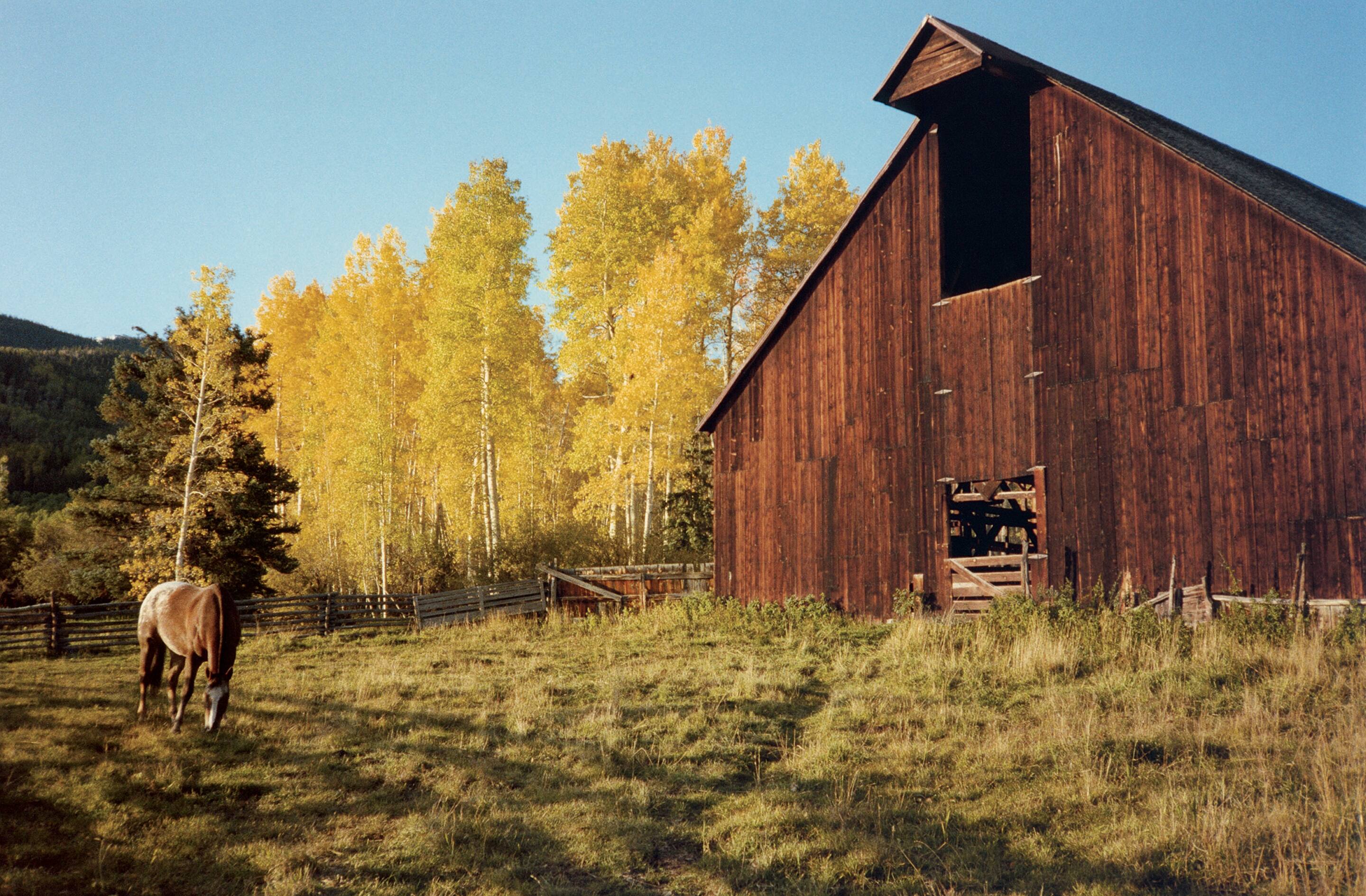
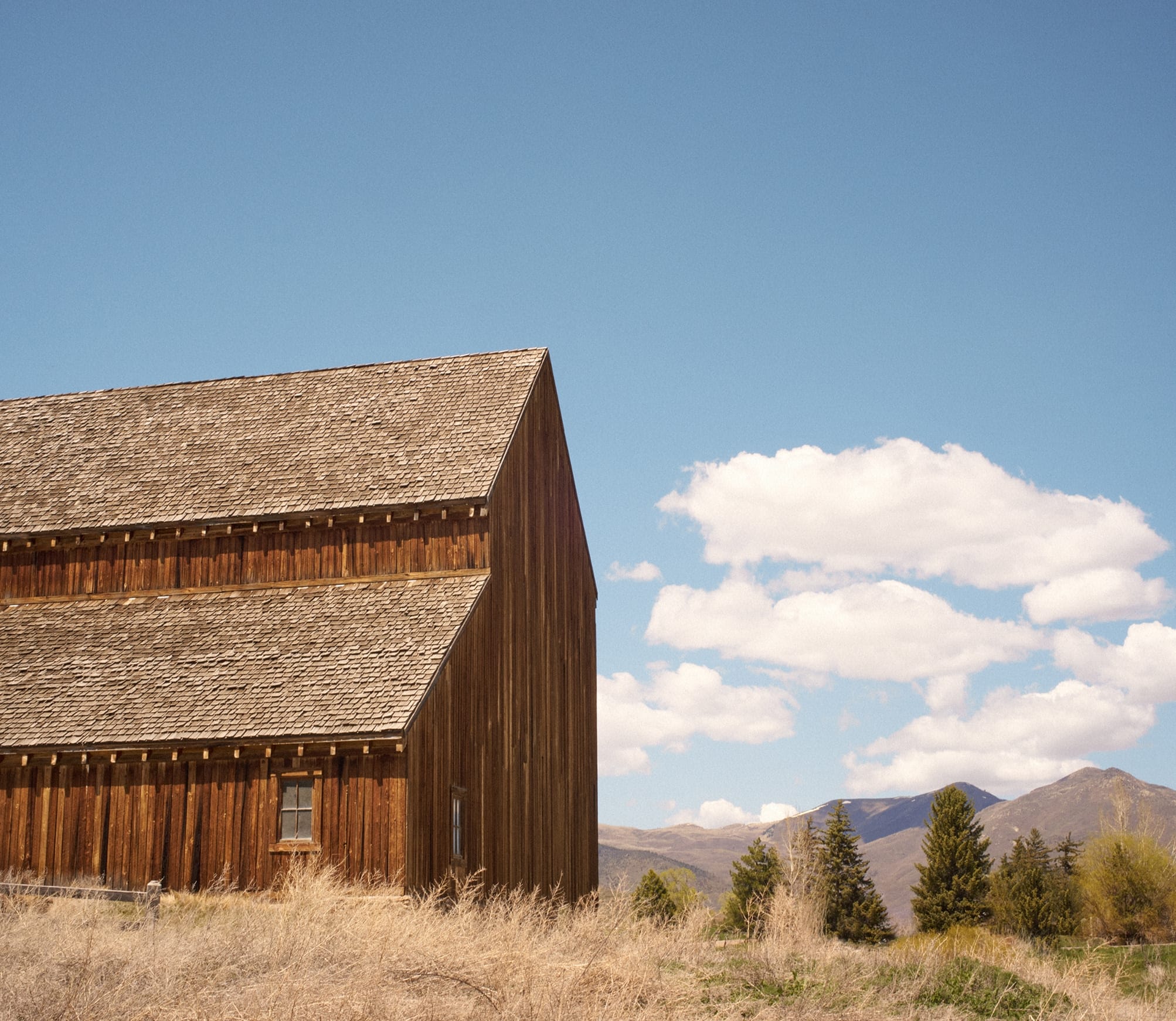
The Tate Barn, in Utah’s Heber Valley, was built in 1902, and still stands at the foot of the Wasatch Mountains as a symbol of expansion and possibility.
For Americans, barns conjure up a whole universe of meanings; they’re as full of symbols, memories, and associations as they are of bales of hay or cows. We speed past them in our cars, with the kids blasting Olivia Rodrigo, sometimes taking note, sometimes not; we take them for granted and love them at the same time. If we do notice, we marvel at their size, the way they suggest integrity, radiate authenticity, connect us to an agrarian past—of craft and hard work and doing things the right way. Barns are unfussy and unfancy, but they tend to make newer, shinier things look shabby and impermanent.
Barns are vernacular cathedrals and their design shares a lineage with those exalted structures. They developed about a millennium ago, in Northern Europe and Britain. Our word comes from the Old English bereærn, combining the bere (barley) and ærn (house or store), which sums it up: It’s where you stashed your grain, which was used to pay tithes and to keep you—and your animals—going throughout the winter months. Barn technology crossed the Atlantic to North America, where it arguably reached its greatest level of expression and variety: stone or timber, painted red or unpainted, cantilevered or not. Amid the coast-to-coast ubiquity, there are gradations of style and inventiveness and peculiarity everywhere, with no easily discernable geographical throughline from east to west. And barns aren’t just for nostalgists. Modernists love them, too. “They’re the quintessentially structuralist architecture 200 years before the structuralist-architecture movement came to be,” the Hudson Valley–based furniture-maker Sam Moyer told me, “in that all of the structure is revealed instead of covered.” Back in my part of the world, the Brandywine Valley, prints of barns from watercolorists of the local tradition graced the walls of every other house, whether that house was built in 1774 or 1974. We were at the doorstep of the Amish Country, which is barn Valhalla, a region synonymous with barns (and barn raisings), all those handsome specimens tricked out with hex signs—which, it is often explained to the non-Amish, have no magical powers but are “chust for pretty.” From growing up, I remember the Amish tobacco barns, with their side slats propped open in order to dry the giant leaves. Thomas Wolfe wrote about such barns in Look Homeward, Angel: “He thought of the great barns of Pennsylvania, the ripe bending of golden grain, the plenty, the order, the clean thrift of the people. And he thought of how he had set out to get order and position for himself, and of the rioting confusion of his life, the blot and blur of years, and the red waste of his youth.” I first read those lines on an Amtrak train to Montreal when I was 19. They felt pretty close to home then. They feel even closer to home now, as I consider them in middle age.
For Americans, barns conjure up a whole universe of meanings; they’re as full of symbols, memories, and associations as they are of bales of hay or cows.
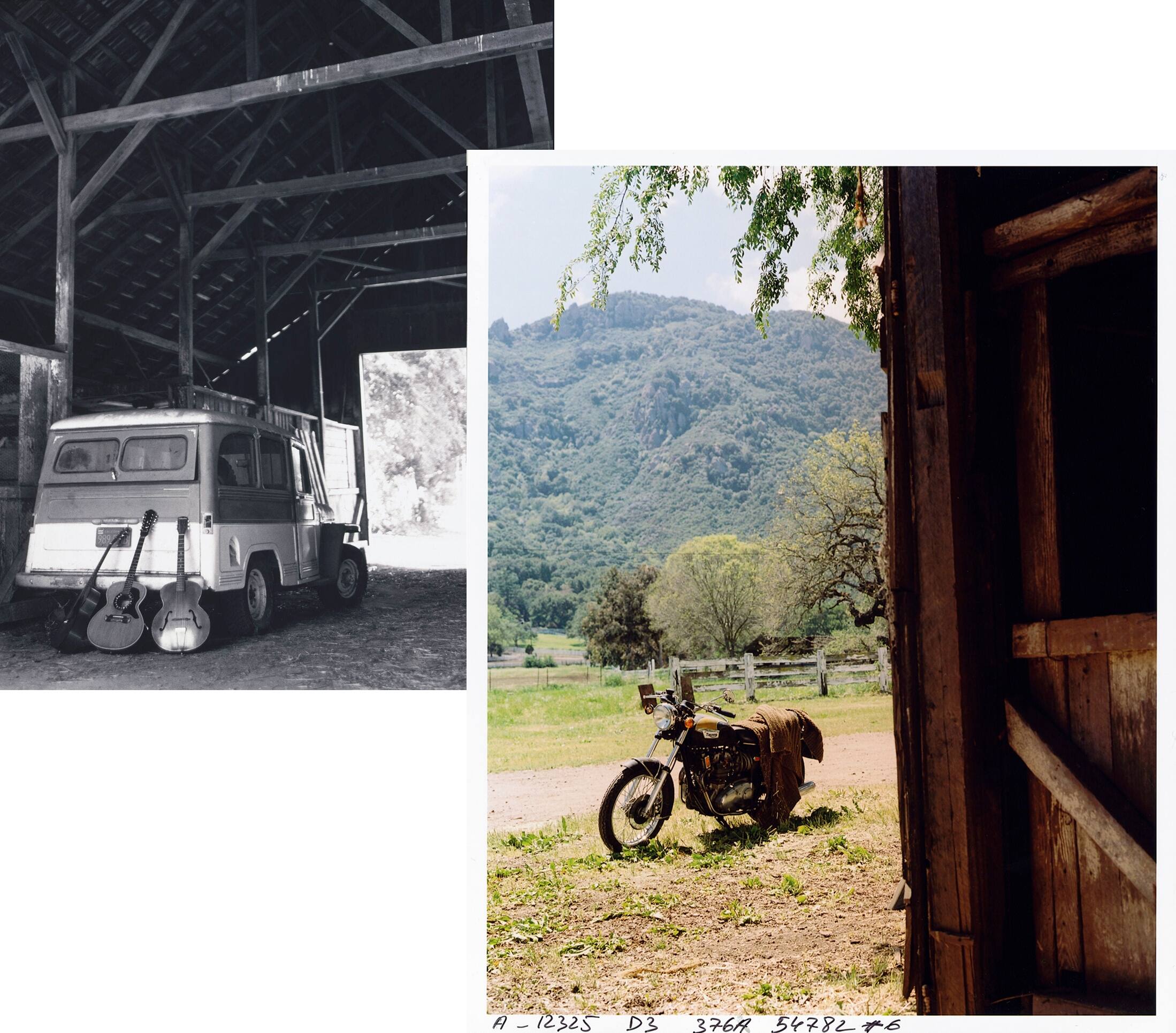
Barns are who we are. For centuries we’ve come together as a community for barn raisings. In the climactic scene of High Noon, a New Mexico barn is set ablaze, a visual bonanza. When Levon Helm, the drummer in The Band, built his studio in Woodstock, New York, he built it in the form of a barn; the design makes for an intimate and atmospheric performance space and concertgoers flock to shows there. “Whose barn, what barn, my barn,” Jerry Lee Lewis sang, pure American rock ‘n’ roll poetry. Barns decorate not only the land, but also the contours of our speech. Of an uncouth person, you might say they were “born in a barn.” When a target is easy or obvious, you talk about “hitting the broad side of a barn.” When an NBA game goes into overtime, it’s a “barn burner.” When your friend’s fly is down: “Your barn door is open.” In Andrew Wyeth’s Christina’s World, a Maine barn sits astride a ridge line, tantalizingly within reach and yet far away: shelter from some unidentifiable storm. Another Maine barn, one that all children know, is the one in E.B. White’s Charlotte’s Web, the home to the titular spider, along with Wilbur the pig, Templeton the rat, and the rest of the gang. White knew this imaginary barn inside and out. It was based on his own, in North Brooklin, Maine. “The barn was very large,” he wrote. “It was very old. It smelled of hay and it smelled of manure. It smelled of the perspiration of tired horses and the wonderful sweet breath of patient cows. It often had a sort of peaceful smell—as though nothing bad could happen ever again in the world.” When it comes to barns and literature, book barns dot the land, piled with vintage and antiquarian books, cavernous places that boast Nothing You Need in a Place Where You Can’t Find It. Baldwin’s Book Barn, on the outskirts of West Chester, Pennsylvania, is the platonic ideal of these, a heavy-beamed, five-story stone barn dating to 1822 crammed with 300,000 books and no end of lore. When I’m back in the old sod, it’s the first stop I make. The aroma of ancient American hardwood (is that perchance white oak?) and moldering tomes—from art books to cookbooks to regimental histories to first editions to old red Baedeker guides—is like the perfume of time.
If barns are such an important, emblematic part of our American life, how many of them are there these days? In 2012, the president of the National Barn Alliance hazarded a guess: maybe 2 million? Sounds like a lot of barns, but a century ago there were 6.5 million farms and nearly all of them had barns. Back then there were 16 people for each barn. Now the ratio is 170:1. Their numbers might be reduced, but barns still have a way of popping up at significant life junctures, at least for me. A niece’s wedding reception in a capacious North Carolina barn, complete with hoedown. A harvest party in the Leatherstocking Region of New York State, at which the super-caffeinated 300-pound Arkansas rockabilly artist Sleepy LaBeef performed in a barn for hours nonstop. A four-star family dinner in a big red barn in the foothills of the Smoky Mountains, in Tennessee. My daughter working on her canter in a horse barn in Florida. Old newspaper clippings recording annual reunions of one branch of our huge Pennsylvanian family, always in the same barn, as related in 1921: “The great barn was set with two long tables seating 80 at a time and the big doors at either side admitted a cool breeze.” More than 200 people attended that year. Another year it was nearly 600. I wonder if they all fit into that old family barn and I wonder if it’s still standing, a boon to its owner and the neighborhood.
It’s hard to think of a more revelatory structure than the gorgeous, red-pine Tate Barn, in Utah’s picturesque Heber Valley. It went up in 1902, but the elements—mainly snow—finally brought it down in 1996. In 2002, a painstaking reconstruction brought it back to life. The Tate Barn stands today like a proud king of barns. It is a symbol of welcome to Wasatch Mountain State Park and a monument to the American West. Many barns aren’t as lucky as the Tate Barn; they never get that level of TLC. We see those barns from the road, too: the swayback roof line, the compromised timbers, the missing shingles, the washed-out RED POUCH advertisement on the side; hobbled yet refusing to fall, too expensive to tear down. It is an albatross for the owner and a magnet for those in search of reclaimed wood. It is also an exemplar of pleasing decay that tells its own heroic story. “America has no noble ruins,” Eric Sloane, the author of An Age of Barns, a barn-spotter’s bible, once wrote—no Acropolis, no Pompeii. What it has is barns.

Mark Rozzo is a contributing editor at Vanity Fair and the author of Everybody Thought We Were Crazy: Dennis Hopper, Brooke Hayward, and 1960s Los Angeles (Ecco).