The authentic and timeless world of Ralph Lauren
April 2025
RL/Culture

Sand Pipers

The Hamptons is famous for both its legendary painters and delicious produce, but its most amazing crop was once the great American writer.

By Jay McInerney
High Times
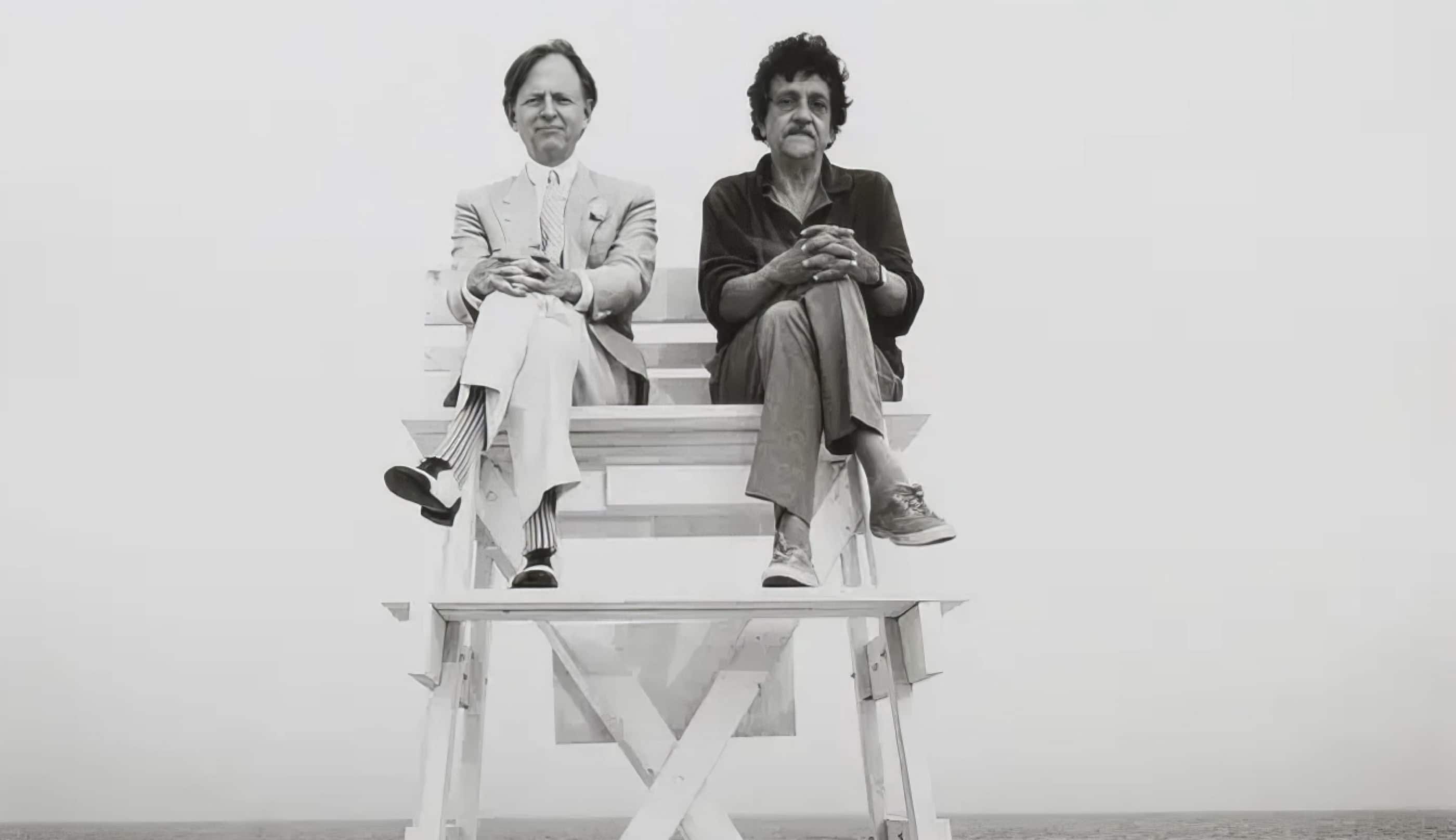
Tom Wolfe and Kurt Vonnegut, the Hamptons, 1985
The painters that have been spending time out here on the east end of Long Island since the late 19th century were in part attracted by the quality of the light—the limpid marine skies influenced by two adjacent bodies of salt water. Beginning with American impressionists like William Merritt Chase and Childe Hassam and stretching into the mid 20th century, first with abstract expressionists like Pollock, Krasner, and de Kooning, and then Warhol and Lichtenstein, painters continue to be drawn here from the stony canyons of Manhattan and beyond. Less remarked upon, but even more compelling to some of us, was the remarkable constellation of literary talent that was attracted to this peninsula commonly known as the Hamptons, in honor of some of the towns which compose it: East Hampton, Bridgehampton, and Southampton. Some come here for the sun and sand, some of the best and most pristine beaches in America, but I came out searching not so much for the sound of waves as the sound of typewriters.
High Times
Tom Wolfe and Kurt Vonnegut, the Hamptons, 1985
The first time I visited the Hamptons was in the early ’80s. I was an aspiring writer, and I stayed with a friend named Scott Sommer who had just published a novel at Random House. I don’t remember much about that weekend except that I was enchanted by the area. The second time I came out from the city I was accompanied by my girlfriend, the model Marla Hanson, who had become a tabloid fixture after being slashed by thugs hired by her disgruntled landlord. I myself had become quite famous as a novelist, and I set about inserting myself into the local literary community. We were staying in Amagansett at the beachside home of Esquire editor Terry McDonell and his wife, whose kids I instructed in the art of surf casting. The house was a lovely clapboard New England colonial, painted barn red, known locally as Lobster House. I remember walking for the first time into the guest room with Marla and watching the white linen curtains billowing out and in, much like the curtains described by F. Scott Fitzgerald in the East Egg home of Tom Buchanan. Back in the ’20s, the writers—Fitzgerald and Ring Lardner among them—didn’t come as far out as the Hamptons, concentrating themselves instead in towns like Great Neck which were closer to the city. Terry introduced me to some of the local talent. The writers seemed to be concentrated in the towns of Sag Harbor and Sagaponack. Among the first dinner invitation we received was to the home of George Plimpton, who’d published my first short story in the Paris Review. Guests at that dinner party included Kurt Vonnegut, John Irving, and Peter Matthhiessen, all of whom lived within a stone’s throw of George on Sagg Main Street, a country lane that terminated at the ocean. I was suitably dazzled. They, in their turn, had been drawn in part by the presence of James Jones, author of From Here to Eternity, who lived just up the street until his death, and whose widow Gloria still threw Sunday parties that attracted the neighbors as well as nearby writers like John Knowles, William Gaddis, James Salter, Willie Morris, and Joseph Heller. Truman Capote, whom I met at Plimpton’s townhouse in Manhattan, had also been a Sagaponack resident, though he died in 1984 just after my first novel, Bright Lights, Big City, was published; Nora Ephron lived just around the corner in East Hampton, and Tom Wolfe close by in Southampton.
Lions in Summer
Clockwise, from top: James Salter, George Plimpton, Nora Ephron, Joseph Heller, Truman Capote, James and Gloria Jones, Jay McInerney.

Terry introduced me to some of the local talent. The writers seemed to be concentrated in the towns of Sag Harbor and Sagaponack. Among the first dinner invitation we received was to the home of George Plimpton, who’d published my first short story in the Paris Review. Guests at that dinner party included Kurt Vonnegut, John Irving, and Peter Matthhiessen, all of whom lived within a stone’s throw of George on Sagg Main Street, a country lane that terminated at the ocean. I was suitably dazzled. They, in their turn, had been drawn in part by the presence of James Jones, author of From Here to Eternity, who lived just up the street until his death, and whose widow Gloria still threw Sunday parties that attracted the neighbors as well as nearby writers like John Knowles, William Gaddis, James Salter, Willie Morris, and Joseph Heller. Truman Capote, whom I met at Plimpton’s townhouse in Manhattan, had also been a Sagaponack resident, though he died in 1984 just after my first novel, Bright Lights, Big City, was published; Nora Ephron lived just around the corner in East Hampton, and Tom Wolfe close by in Southampton. For a couple of summers I attended dinner parties on Sagg Main, at the Irvings’, the Jones’, the Plimptons’, and the Matthiessens’, as well as the nearby home of Richard Price and his wife, the painter Judy Hudson. I wish I had taken notes. Sagaponack was recently named the most expensive zip code in the country, so I don’t think it will attract many writers in the future. Besides Sagaponack, the other center of literary domesticity was Sag Harbor, the former whaling town which is mentioned in Moby Dick as a den of iniquity, and which was once the home of James Fenimore Cooper. Sag Harbor was for many years the address of John Steinbeck, when it was still essentially a blue-collar community populated by the workers at the watch factory. Steinbeck was said to enjoy his relative anonymity in the community. About a decade ago, I was invited to tour the house and property by a couple of his descendants, who still owned it. The house is surrounded by water, a little peninsula oasis at the edge of the town, which might have succumbed to the voracious appetite for waterfront residential real estate but instead has just been turned into a museum and opened to the public. Nelson Algren, E.L. Doctorow, Colson Whitehead, Spalding Gray, Thomas Harris, Amor Towles, and Wilfrid Sheed all have called Sag Harbor home. A few of us are still out here. And while the two-lane highway is more congested, and the real estate prices are dizzyingly high, and the nouveau riche barbarians have breached the hedges, it’s still one of the more beautiful places on earth. And we will always have that history of once being the most populous and illustrious rural writer’s colony in America.

Jay McInerney is the author of nine novels, including See You on the Other Side, forthcoming from Knopf in 2026.